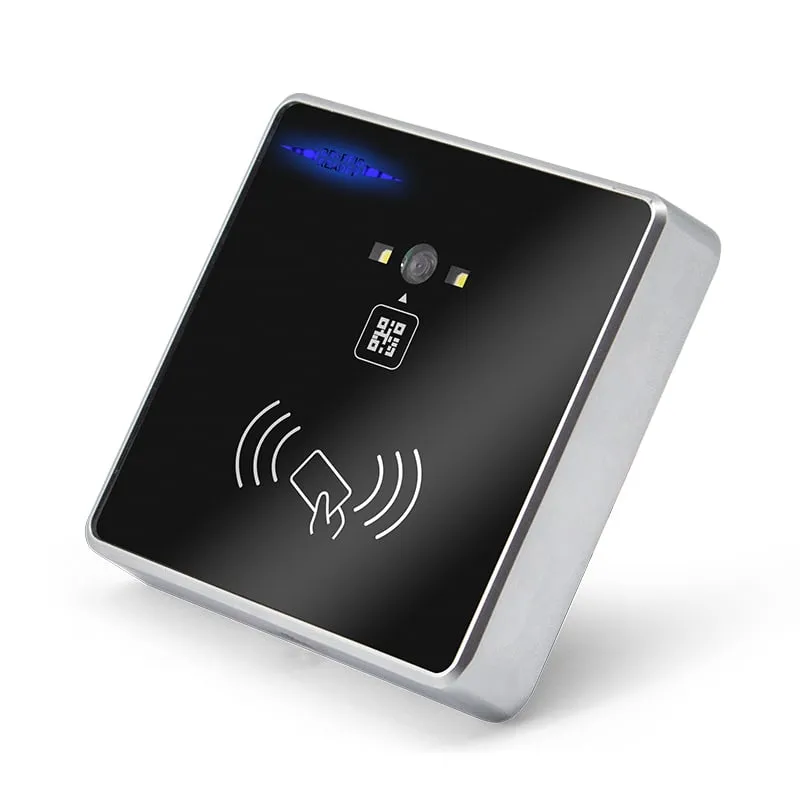
 QR + RFID
 Q420-M
QR Code + RFID Access Reader, Wiegand 26/34, RS485, Slim 86-Box
- RS232
- RS485
- Wiegand
- Wall-mount
Read range: 3–6 cm
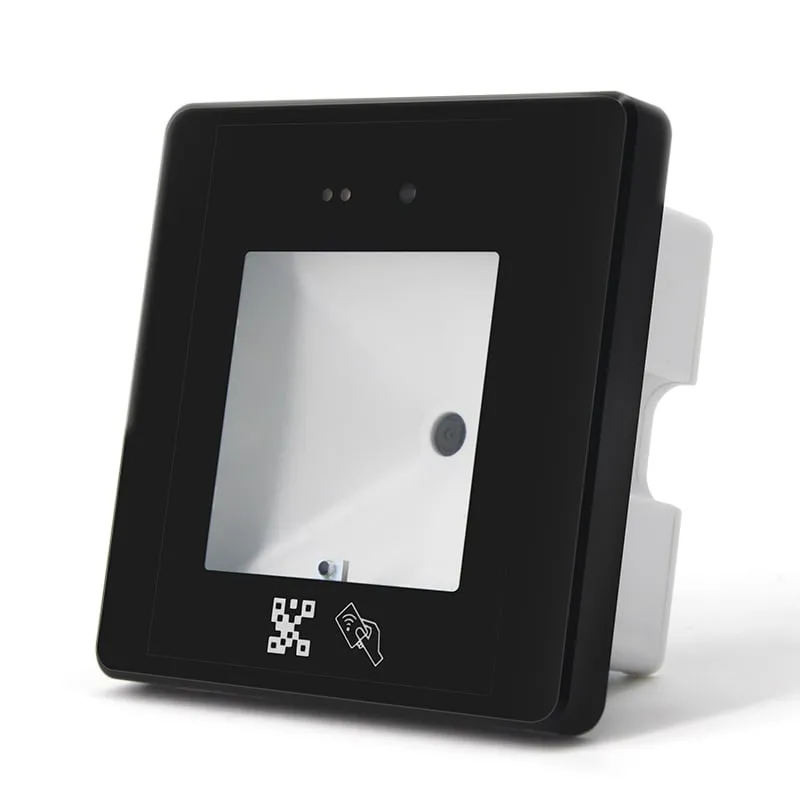
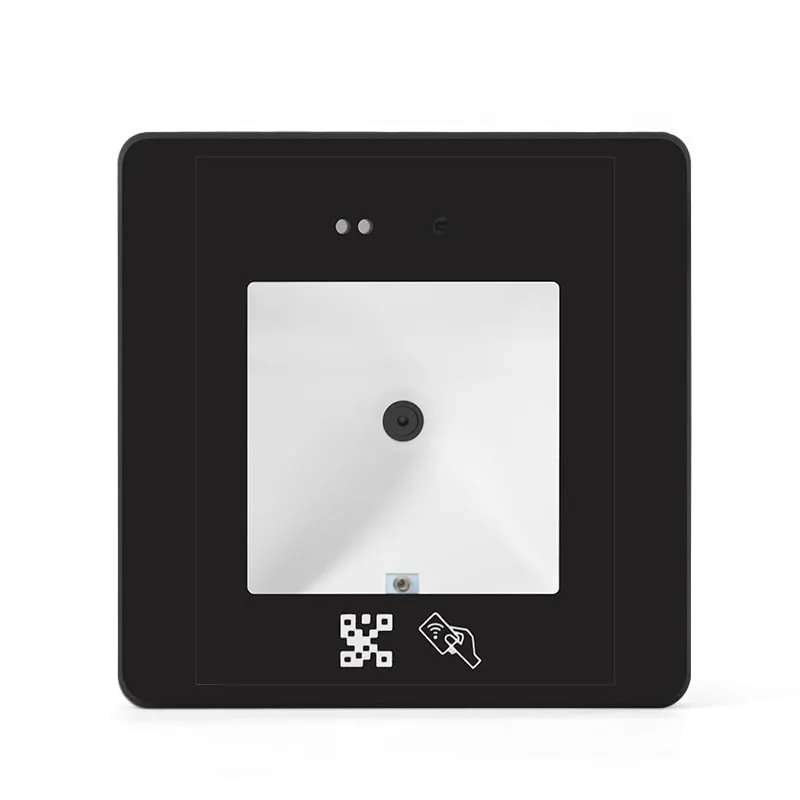
The Q430-M is an 86-box QR code and RFID reader for turnstiles, doors and check-in desks that need more than one output. It reads QR and 1D/2D codes at 0–20 cm and EM or MIFARE cards at 3–6 cm, with Wiegand, RS232, RS485 and TTL on a terminal block plus mini-USB keyboard or virtual COM output.
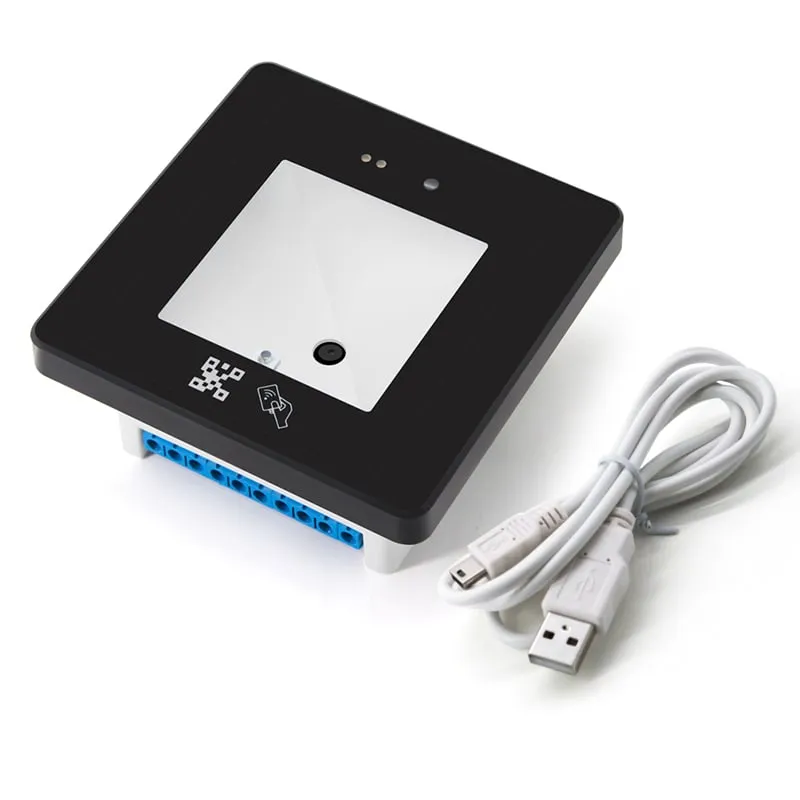
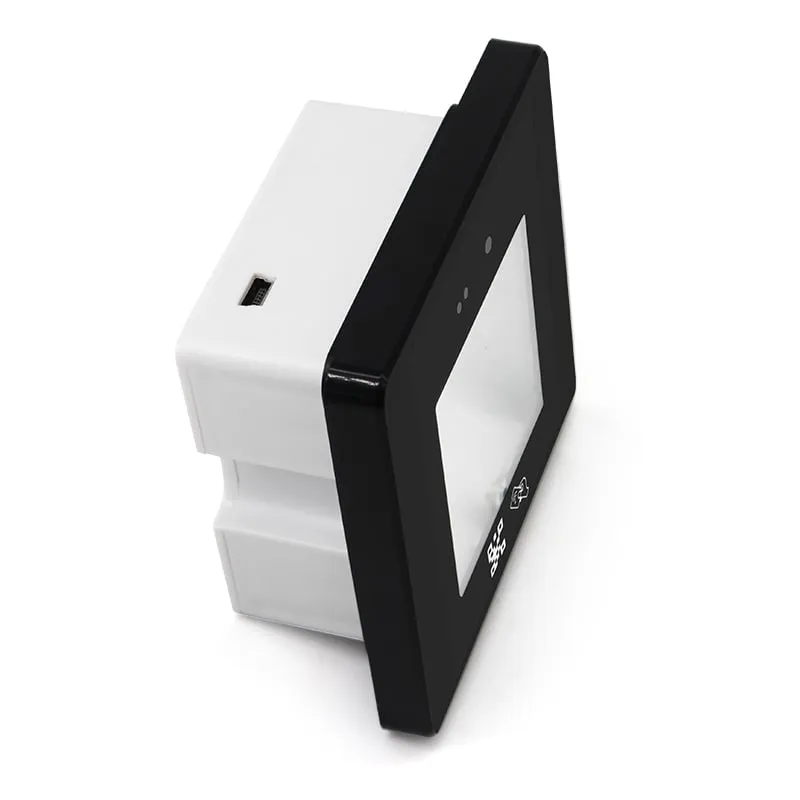
Besides its panel outputs, the Q430-M has a mini-USB port with two modes. In keyboard mode it types the decoded QR content or card number into whichever field has focus, so visitor check-in, attendance or membership software that accepts typed input needs no changes. In virtual COM mode, applications read the same data from a serial port. Windows XP/7/8/10 and Linux are listed hosts.
The same model can therefore serve a reception desk that logs visitors into a PC, or a turnstile wired to the gate board over RS485. Keyboard-wedge readers explained compares keyboard and COM modes, and other keyboard-output models are listed under keyboard emulation readers.
All panel connections land on a 10-way terminal block on the rear box, which suits turnstile cabinets and installers who terminate cable on site.
| Terminal | Use |
|---|---|
| 12 V, GND | Power, 8–12 V DC, 800 mA supply |
| WG-D0, WG-D1 | Wiegand to an access controller |
| 485-A, 485-B | RS485 to a turnstile or elevator board |
| 232-TX, 232-RX | RS232 to a host |
| TTL-TX, TTL-RX | TTL serial to an embedded board |
Card reading is set by setting code to IC only (13.56 MHz MIFARE) or IC + ID (MIFARE plus 125 kHz EM). Over Wiegand, QR content is sent as decimal by default, so issue visitor codes your controller can store as card numbers. The overall depth is 42 mm; plan an 86 mm wall box or turnstile cut-out for the rear box. For a slimmer 18 mm reader without USB, see the Q420-M; other serial-output models are listed under RS232 and RS485 RFID readers.
| Model | Q430-M |
|---|---|
| Type | QR code + RFID access control reader |
| Form factor | 86-box wall mount with rear terminal box |
| Housing | PC with tempered-glass scan window |
| Color | Black front panel |
| Card frequency | 125 kHz / 13.56 MHz |
|---|---|
| Card standards | EM4100; ISO/IEC 14443A (MIFARE) |
| Supported cards | EM cards, MIFARE cards (card number read) |
| Card mode | IC only or IC + ID (set by setting code) |
| Codes | QR codes and 1D/2D barcodes |
| Barcode decoding | CMOS |
| Card read range | 3–6 cm |
| QR code read distance | 0–20 cm |
| Reading angle | 45°, centered on the lens |
| Read speed | < 200 ms |
| Scan trigger | Automatic sensing, buzzer prompt |
| Interfaces | Wiegand, RS232, RS485, TTL, USB (mini-USB) |
|---|---|
| USB modes | Keyboard emulation or virtual COM port |
| Wiegand output | QR content as decimal by default |
| TCP/IP | Ask in your RFQ; availability confirmed in your quotation |
| Configuration | Scan setting codes: baud rate, card mode |
| Terminal block | 485-B, 485-A, 232-RX, 232-TX, WG-D1, WG-D0, TTL-RX, TTL-TX, GND, 12 V |
| Host OS | Windows XP / 7 / 8 / 10, Linux |
| Indicators | Red work light, green feedback light, green network light |
| Factory reset | Pin-hole Reset button on the back |
| Power supply | 8–12 V DC, 800 mA |
|---|---|
| Dimensions | 86 × 86 × 42 mm |
| Weight | 150 g |
| Operating temperature | -20 °C to +70 °C |
| Humidity | 10–90 % RH |
Specifications of Q430-M as supplied for the standard version. Read range depends on the card or tag, mounting surface and environment — we can test your own cards before you order.
Works with
Not designed for
Card not listed? Send us the card type or a photo and we will confirm compatibility before you buy.
Seat the rear terminal box in an 86 mm wall box or turnstile cut-out; the reader measures 86 × 86 × 42 mm overall.
Wire 12 V and GND to an 8–12 V DC supply rated for 800 mA, then WG-D0/WG-D1 to the controller, or 485-A/485-B, 232-TX/232-RX or TTL-TX/TTL-RX to your host board.
For PC software, connect the mini-USB port and use keyboard emulation or virtual COM mode, depending on how your software reads input.
Scan the setting codes for card mode (IC only or IC + ID) and baud rate. If a setting goes wrong, press the pin-hole Reset button on the back to restore factory defaults.
Yes. In keyboard mode the mini-USB port types the QR content or card number into the active field of any program. In virtual COM mode the data arrives on a serial port instead. Windows XP/7/8/10 and Linux are listed hosts.
TCP/IP is not part of the confirmed specification. The confirmed outputs are Wiegand, RS232, RS485, TTL and mini-USB. If your project needs a network connection, ask for TCP/IP in your RFQ; whether a network build can be supplied is confirmed in your quotation.
By default the Q430-M sends QR content over Wiegand as a decimal number, the same way a controller receives a card. Your visitor system should issue QR codes whose content the controller can store as a card number.
Insert a pin into the Reset hole on the back of the reader. The reader restarts automatically with its factory settings; then release the pin.
The Q430-M is 42 mm deep with a PC housing, tempered-glass window, terminal block and mini-USB output. The Q420-M is 18 mm deep with a zinc-alloy frame and flying leads, and has no USB. Both read QR codes at 0–20 cm and EM/MIFARE cards at 3–6 cm.
QR + RFID Q420-M
Read range: 3–6 cm
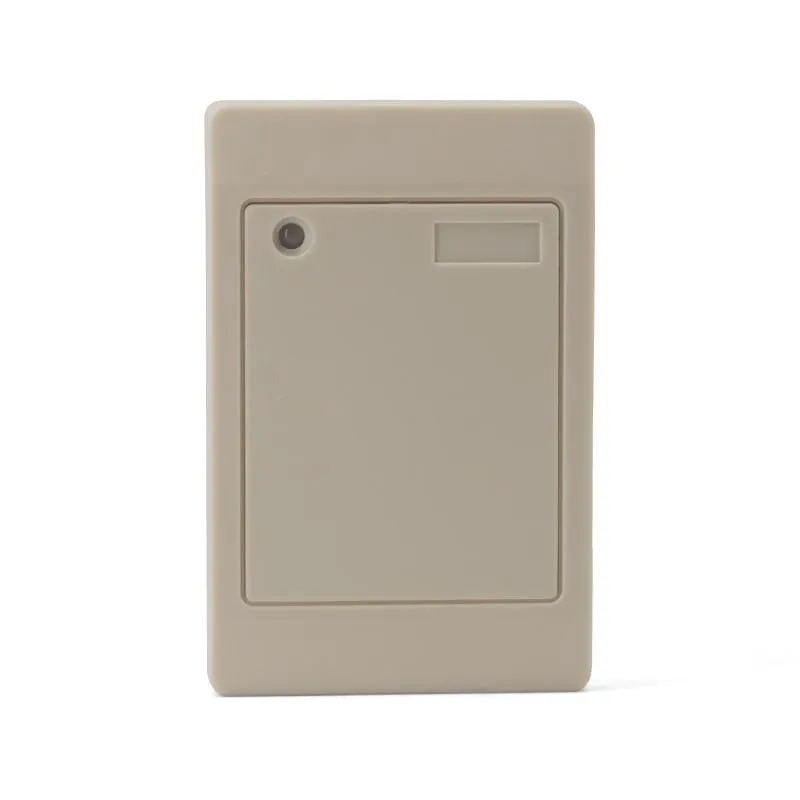 125kHz
 L410-W+2 variants
Read range: 0–100 mm
 125kHz
 Tell us your card, interface and quantity
Send the card or tag type, the host system and your volume. We reply within 1 business day with a suggested model and sample options.