Animal ID
FDX-B vs HDX Animal Tags: How They Differ and What Your Reader Must Support
By Henrium · · 8 min read
Quick answer
FDX-B and HDX are the two ways ISO 11785 lets a 134.2kHz animal tag send the same 64-bit ISO 11784 ID. An FDX-B tag replies while the reader's field is on. An HDX tag stores energy, then replies while the field is off. A reader reads HDX tags only if it supports HDX.
Every electronic ear tag, bolus and pet microchip made to ISO 11784 and ISO 11785 carries the same kind of 64-bit ID. The tag can send it in one of two ways: FDX-B (full duplex) or HDX (half duplex). The ID is the same. The radio link is not, and a reader built for one of them may not detect the other.
For a buyer, the question is not which protocol is better on paper. It is which tags your animals already carry, and whether the reader you choose can read all of them. This guide explains how each protocol works, where each is used, and what to check before you buy.
Same ISO 11784 number, two ways to send it
The two standards divide the work:
- ISO 11784 defines the code: a 64-bit structure with an animal flag, a 10-bit country or manufacturer code and a 38-bit national ID. Readers usually show it as a 15-digit number. See ISO 11784/11785 explained for the full bit layout.
- ISO 11785 defines how a reader powers the tag and receives that code. It sets the carrier at 134.2kHz and describes two tag types, FDX-B and HDX. It also expects a full ISO reader to read both.
So “ISO 11784/11785 compatible” alone does not tell you whether a reader handles HDX. Many readers, including all of ours, read FDX-B only on the 134.2kHz side. The data sheet should name each protocol.
How FDX-B works
FDX-B stands for full duplex, type B. “Full duplex” means the tag talks while the reader is still transmitting.
- The reader keeps a continuous 134.2kHz field on.
- The tag’s coil takes power from that field and the chip starts at once.
- The tag sends its code by switching a load on and off, which changes the amplitude of the reader’s field slightly (amplitude shift keying).
- Bits use differential biphase coding. Each bit lasts 32 carrier cycles, so the data rate is 134.2kHz ÷ 32 ≈ 4.19 kbit/s.
- One telegram is 128 bits: an 11-bit header, the 64 ID bits, a 16-bit CRC and 24 bits of extension data, with a control bit after every 8 data bits. At that rate one telegram takes about 30.5 ms, and the tag repeats it for as long as it stays in the field.
The difficulty for the reader is that the tag’s reply is very weak next to the reader’s own carrier. The receiver has to pick it out while the transmitter is running.
How HDX works
HDX stands for half duplex. The tag and reader take turns.
- The reader transmits a charging burst at 134.2kHz, typically about 50 ms long.
- The tag stores that energy in a capacitor.
- The reader switches its field off and listens.
- The tag replies on its stored energy using frequency shift keying: 134.2kHz for a 0 and 124.2kHz for a 1, with each bit lasting 16 cycles, which is roughly 8 kbit/s.
- One HDX telegram is 112 bits: an 8-bit header (01111110), the 64 ID bits, a 16-bit CRC and 24 bits of extension data. It takes about 14 ms.
Because the reader’s transmitter is silent while the tag is talking, the receiver is not listening against its own carrier. That is the main reason HDX is often chosen where reads must work at a distance or near electrical noise.
FDX-B vs HDX at a glance
| Feature | FDX-B | HDX |
|---|---|---|
| Standard | ISO 11784 code, ISO 11785 air interface | ISO 11784 code, ISO 11785 air interface |
| Reader carrier | 134.2kHz, on continuously | 134.2kHz, switched on and off |
| When the tag replies | While the field is on | While the field is off |
| Tag signal | Amplitude shift keying, differential biphase | Frequency shift keying, 134.2 / 124.2kHz |
| Data rate | About 4.19 kbit/s | Roughly 8 kbit/s |
| Telegram | 128 bits, about 30.5 ms | 112 bits, about 14 ms |
| Tag power | Directly from the field | Stored in a capacitor |
| ID content | 64-bit ISO 11784 code, 15-digit display | Same |
| Common uses | Pet microchips, laboratory animals, many sheep, goat and cattle tags | Many cattle ear tags and boluses, fish-tracking PIT tags |
| Reader needed | FDX-B or full ISO reader | HDX or full ISO reader |
Practical differences in the field
Read range
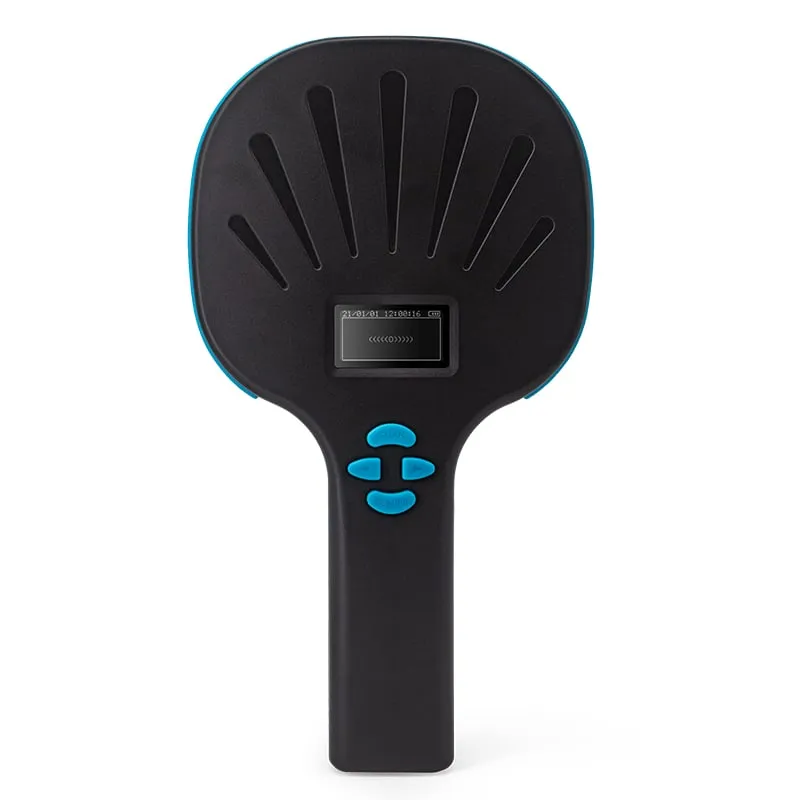
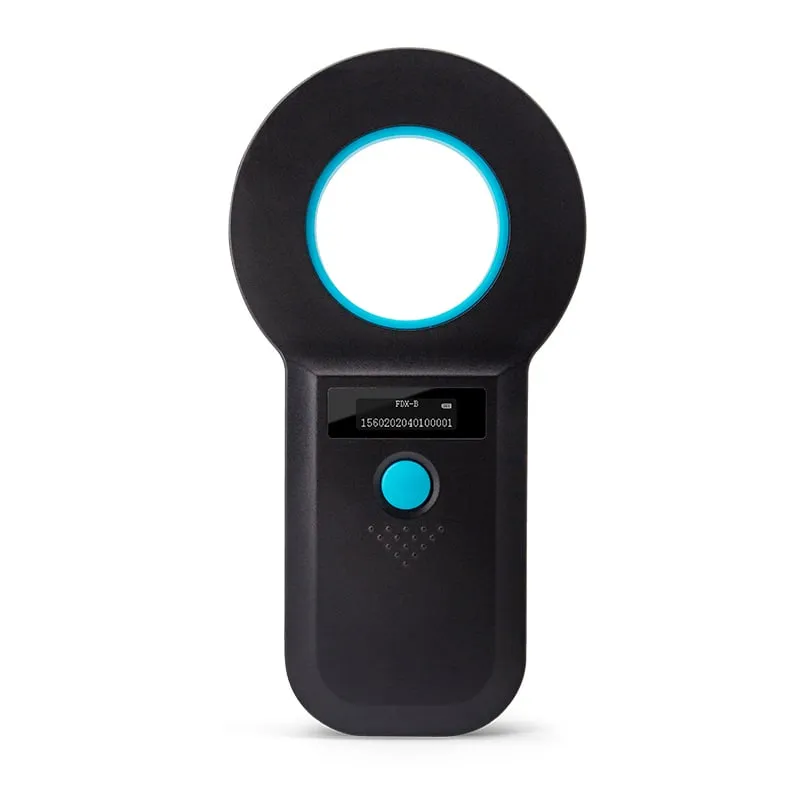
Tag size matters more than protocol. A 30 mm ear tag has a much larger coil than a small glass microchip, so it reads further with the same reader. Our handhelds show the effect: the A520-M Bluetooth animal tag handheld reads 30 mm FDX-B ear tags at more than 20 cm but 2–12 mm glass-tube microchips at more than 8 cm. The A540-M reads the same ear tags at more than 25 cm and 2–12 mm glass-tube microchips at more than 15 cm.
Between protocols, vendors often quote longer ranges for HDX than for FDX-B tags of similar size, because the HDX reply arrives while the reader is quiet. The difference depends on the tag, the antenna and the site, so compare published figures for the exact tag and reader you plan to use, not general claims.
Electrical noise and metal
Low-frequency readers pick up noise from motors, variable-speed drives, switching power supplies, fence energizers and mains cables. An FDX-B receiver must hear a weak reply while its own carrier is on, so noise cuts its range sooner. HDX is less sensitive to this, though not immune.
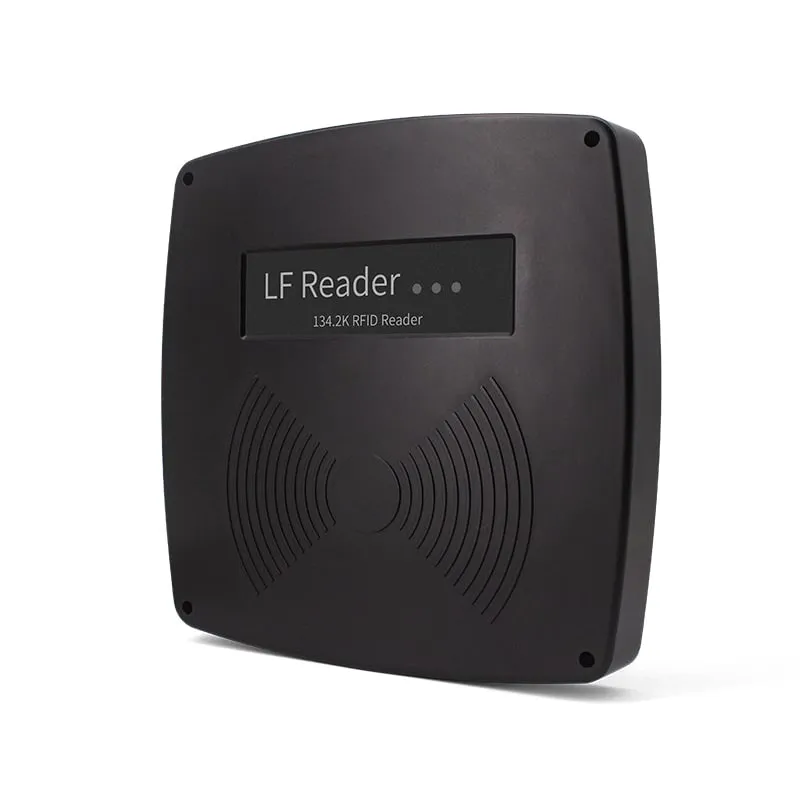
Metal affects both. Steel crushes, gates and scale platforms detune the antenna and absorb the field whatever the protocol. When you plan a fixed reader such as our A660-M 134.2kHz EID panel reader, keep it as far from large steel parts as the layout allows, and measure the read range at the actual mounting point before you fix it in place.
Moving animals
At a race or feeder the tag has to stay in the read zone long enough for the reader to receive a full, CRC-checked telegram. As a worked example, an ear tag moving at 1 m/s crosses a 40 cm read zone in about 0.4 s, time for more than ten FDX-B telegrams. In practice tag orientation matters more than speed. A tag reads best when its coil faces the reader’s antenna, and the same tag turned 90° can read at a fraction of that distance. Test with your own animals at their normal pace before fixing the antenna position.
Neither protocol, as used for basic ISO animal ID, can separate several tags in the field at once. When two tags are in range together, the reader often gets no valid read, or reads only the stronger tag, so keep animals in single file at a race.
Which tags you will meet
- Pets. Most companion-animal microchips are FDX-B. HDX pet chips are uncommon, and some older pets still carry non-ISO 125kHz chips.
- Livestock. Both protocols are in use. HDX is widespread in cattle ear tags and ruminal boluses in some national programs; FDX-B is common in sheep and goat tags and in many cattle tags. Your national program’s approved-device list is the reference, not the tag’s appearance. For FDX-B cattle and sheep tags, see our livestock EID ear tag readers.
- Fish and wildlife research. PIT tags come in both types. HDX is often chosen for large in-stream antennas.
Where EMID and FDX-A fit
Two older low-frequency formats still turn up in animal work:
- EMID is a 125kHz code of the EM4100 type, used in some animal tags. It is not ISO 11784 and carries no country code; readers show it as a shorter number, such as 10 decimal digits. The EM4100 guide explains the format.
- FDX-A is a 125kHz full-duplex format that predates ISO 11785. ISO 11785 has an annex on reading older tags of this kind, but an FDX-A tag does not carry an ISO 11784 code.
Some older pet microchips also use other non-ISO 125kHz or 128kHz formats. A scanner described as “universal” should list each format it reads. Our readers read EMID but not FDX-A or the other non-ISO formats.
What our readers support
All our 134.2kHz animal ID readers read FDX-B tags at 134.2kHz and EMID tags at 125kHz. They are read-only: they read the tag’s ID and cannot write or change it. None of them reads HDX.
| Model | Type | FDX-B | EMID | HDX | Read range (tag dependent) |
|---|---|---|---|---|---|
| A660-M | Fixed panel, RS232/RS485 | Yes | Yes | No | 40 cm ± 5 cm |
| A540-M | Handheld with 1D/2D barcode | Yes | Yes | No | Ear tag > 25 cm; glass tube > 15 cm |
| A520-M | Handheld, USB/2.4G/Bluetooth | Yes | Yes | No | Ear tag > 20 cm; glass tube > 8 cm |
| A530-U | Handheld, USB | Yes | Yes | No | Ear tag > 15 cm; glass tube > 5 cm |
| A110-U, A140-U | USB desktop | Yes | Yes | No | 0–150 mm |
| A220-C | USB-C plug-in for Android | Yes | Yes | No | 0–30 mm |
These readers suit pet clinics, shelters, research units and farms whose tags are FDX-B, and integrators building feeders, scales or race readers around FDX-B tags. If your herd carries HDX tags, or a mix of HDX and FDX-B, you need a reader that supports both, and that is not in our current range.
Checklist: matching a reader to your tags
- List every tag type in use. Include older tags still on animals, replacement tags and tags on animals bought in from other farms.
- Confirm the protocol of each. Use the data sheet, the supplier or your national program’s device list. Do not rely on “ISO” alone.
- Read the reader specification line by line. It should name FDX-B, HDX, EMID and any non-ISO formats separately.
- Check range for your tag size. Compare published figures for glass-tube microchips and for ear tags of the size you use, not a single headline range.
- Survey the site. Note motors, drives, power supplies and steel structures near the read point, and plan a test at that spot.
- Plan for moving animals. Single-file races, a tag angle that faces the antenna and a test at normal walking pace.
- Fix the output format. Decide whether your software stores the 15-digit decimal ID or another string, and how the reader connects: USB keyboard, Bluetooth, RS232 or RS485. The interface guide compares the options.
- Test with your own tags. Order sample readers, or describe your tags in your inquiry. Whether our FDX-B readers fit your tags and output format is confirmed in your quotation.
Frequently asked questions
Can an FDX-B reader read HDX tags?
Only if it also supports HDX. An HDX tag transmits only while the reader's field is off, and it uses frequency-shift keying, which an FDX-B-only receiver does not decode. To an FDX-B-only reader an HDX tag appears as no tag at all. Check that HDX is named in the reader's specification.
Is HDX better than FDX-B?
Neither is better for every job. HDX replies while the reader's transmitter is off, which helps range and reading near electrical noise, so it is common in cattle ear tags and in fish-tracking systems with large antennas. FDX-B is used in most pet microchips and in many livestock tags. Choose the protocol your national program or tag supplier specifies.
Do FDX-B and HDX tags use different ID numbers?
No. Both carry the same 64-bit ISO 11784 code, shown as a 15-digit number: a 3-digit country or manufacturer code plus a 12-digit national ID. Only the radio link differs. Once a reader has decoded the tag, your software gets the same kind of number from either protocol.
Do Henrium animal readers read HDX tags?
No. Our 134.2kHz readers read FDX-B tags at 134.2kHz and EMID tags at 125kHz. HDX and FDX-A tags are not supported, and our current range has no HDX reader. If any of your tags are HDX, choose a reader that lists HDX support.
How do I find out whether my ear tags are FDX-B or HDX?
Check the tag data sheet or packaging, ask the tag supplier, or look up the tag model in your national program's list of approved devices. If an FDX-B-only reader finds no tag at close range, the tag may be HDX, a non-ISO format or damaged.
Readers mentioned in this guide
 134.2kHz
 A660-M
Long-Range 134.2kHz FDX-B Panel Reader, RS232 / RS485
- RS232
- RS485
- Fixed / long-range
Read range: 40 cm ± 5 cm
 134.2kHz
 A540-M
134.2kHz FDX-B Animal Tag Reader with 1D/2D Barcode Scanner
- USB
- Wireless
- Handheld
Read range: > 15 cm
 134.2kHz
 A520-M
Handheld 134.2kHz FDX-B Microchip Reader, USB / 2.4G / Bluetooth
- USB
- Wireless
- Handheld
Read range: > 8 cm
 134.2kHz