Technology explained
NFC Reader vs RFID Reader: Can an NFC Reader Read 125kHz Cards?
By Henrium · · 7 min read
Quick answer
NFC is a 13.56MHz subset of RFID. An NFC reader, including a phone, reads 13.56MHz cards and tags such as MIFARE and NTAG, but it cannot read 125kHz EM4100 or TK4100 cards, 134.2kHz animal microchips or UHF tags. No app or update changes this. Those tags need a reader built for their frequency.
Every NFC reader is an RFID reader, but most RFID readers are not NFC readers. NFC is one slice of RFID: a group of 13.56MHz standards. So the answer to “can an NFC reader read 125kHz cards?” is no, and no app, driver or firmware update will change it.
This guide maps which reader reads which tag, explains why the bands do not mix, and lists the hardware options when a phone or an NFC reader is not enough.
NFC is a 13.56MHz subset of RFID
RFID is any system in which a reader identifies a tag by radio. Passive RFID tags, the kind without a battery, mostly work in three bands:
- LF (low frequency): 125kHz for proximity cards and 134.2kHz for animal ID.
- HF (high frequency): 13.56MHz for smart cards, NFC tags and library labels.
- UHF (ultra-high frequency): 860–960 MHz for EPC Gen2 labels read at a distance.
NFC (Near Field Communication) lives only in the HF band. Its core protocol is NFCIP-1, published as ISO/IEC 18092 and by Ecma International as ECMA-340. NFC devices are designed to work with ISO/IEC 14443 A and B cards, FeliCa (JIS X 6319-4) and ISO/IEC 15693 labels, and the NFC Forum publishes the tag and data-format specifications on top. The NFC Forum describes NFC’s typical range as up to about 2 cm; the short range is intentional.
An NFC device can work in three modes:
- Reader/writer: reads and writes NFC tags, as a phone does when you tap a tag.
- Card emulation: behaves like a contactless card, as a phone does for mobile payments.
- Peer-to-peer: exchanges data directly with another NFC device.
A classic RFID reader does only the first job, often only the reading half of it.
Frequency map: which reader reads which tag
| Band | Typical tags | Typical read range | NFC phone? | Reader you need |
|---|---|---|---|---|
| LF 125kHz | EM4100, TK4100 proximity cards and key fobs | A few cm (our desktop pads: up to 80 mm) | No | 125kHz reader |
| LF 134.2kHz | FDX-B animal microchips and ear tags (ISO 11784/11785) | A few cm to tens of cm, by tag size | No | 134.2kHz animal ID reader |
| HF 13.56MHz | MIFARE Classic, MIFARE Ultralight, NTAG (ISO/IEC 14443A) | Up to about 10 cm | Yes; data access varies by chip | 13.56MHz NFC reader |
| HF 13.56MHz | ICODE labels (ISO/IEC 15693) | Up to 80 mm on our desk reader; more with large antennas | Yes on most NFC phones | ISO/IEC 15693 reader, such as the H155-U USB ICODE reader |
| UHF 860–960 MHz | EPC Gen2 / ISO/IEC 18000-63 labels | Up to 0.5 m on our desktop reader/writers; meters on fixed readers | No | UHF reader |
Only the two HF rows are NFC territory. Everything else needs a reader built for that band.
Why an NFC reader cannot read 125kHz cards
Three things stand in the way, and none of them is software.
- Antenna tuning. An NFC antenna is a resonant circuit tuned to 13.56MHz. A 125kHz card’s coil is tuned to a frequency about 108 times lower. Neither draws usable power from, or answers on, the other’s field.
- Protocol. An EM4100 card starts sending its ID as soon as it is powered (the tag talks first), using amplitude modulation with Manchester coding at about 2 kbit/s. An ISO/IEC 14443 card waits for commands from the reader (the reader talks first) at 106 kbit/s. An NFC controller has no decoder for the EM4100 signal.
- Hardware, not apps. The frequency is fixed by the NFC chip and antenna inside the phone or reader. An app cannot retune it, whatever an app-store listing suggests.
The same applies to 134.2kHz pet microchips and to UHF tags. It also works the other way: a 125kHz reader cannot read MIFARE or NTAG cards. For a closer comparison of the two card bands, see 125kHz vs 13.56MHz.
NFC reader vs RFID reader: side by side
| Feature | NFC reader | RFID reader (general) |
|---|---|---|
| Frequency | 13.56MHz only | 125kHz, 134.2kHz, 13.56MHz or 860–960 MHz, depending on the model |
| Standards | ISO/IEC 18092, ISO/IEC 14443 A/B, FeliCa, ISO/IEC 15693, NFC Forum tag types | EM4100 (LF), ISO 11784/11785 (animal ID), ISO/IEC 14443 and 15693 (HF), ISO/IEC 18000-63 (UHF) |
| Read range | A few centimeters by design | Millimeters to meters, depending on band and antenna |
| Modes | Reader/writer, card emulation, peer-to-peer | Reader interrogates tags |
| Typical data | NDEF records (URLs, text) on NFC Forum tags | Tag ID (UID or EPC), plus chip memory on some tags |
| Typical devices | Phones, PC NFC readers, payment terminals | Desktop, wall, handheld and gate readers |
| Typical uses | Tap-to-open links, access and membership cards, mobile payment | Access control, attendance, livestock ID, inventory, vehicle access |
NFC tag types, and what a UID reader sees
The NFC Forum defines five tag types. Each is built on an existing HF standard:
| NFC Forum type | Based on | Example chips |
|---|---|---|
| Type 1 | ISO/IEC 14443A | Early tag type, uncommon in new projects |
| Type 2 | ISO/IEC 14443A | NTAG203, NTAG213, MIFARE Ultralight |
| Type 3 | FeliCa (JIS X 6319-4) | FeliCa |
| Type 4 | ISO/IEC 14443 A or B, with ISO/IEC 7816-4 commands | MIFARE DESFire |
| Type 5 | ISO/IEC 15693 | ICODE |
MIFARE Classic is not an NFC Forum tag type. It uses the ISO/IEC 14443A radio layer with a proprietary security scheme, so many phones detect it but only some can read its data.
Our 13.56MHz readers read the UID of ISO/IEC 14443A cards and tags: MIFARE Classic 1K (S50) and 4K (S70) and NTAG203, plus NTAG213 on models that list it, such as the H110-R and H150-U. The ISO/IEC 15693 model, the H155-U, reads ICODE labels instead. They output the UID as a number. They do not read NDEF records or card sectors, do not write tags and do not emulate cards. In NFC terms they are UID readers.
For many business systems that is all the software needs: an access list, an attendance log or a membership database is keyed on the card number. If your application must read a URL stored on an NTAG, or write NDEF data, you need an NFC reader/writer and matching software. Our current 13.56MHz range does not include one.
NTAG tags carry a 7-byte UID, which is longer than the 4-byte UID of most MIFARE Classic 1K cards. If you use them, tell us so the output format can be confirmed before shipment. The card number formats guide explains the difference.
Can a phone read RFID cards?
Partly. A phone is an NFC reader, so it reads what NFC reads and nothing else.
- Android phones with NFC read 13.56MHz tags through an app written for the Android NFC interface. Support for MIFARE Classic data depends on the phone’s NFC controller.
- iPhones read NFC tags through apps that use Apple’s Core NFC framework. Like Android phones, they cannot read 125kHz, 134.2kHz or UHF tags.
- Phones and tablets without NFC read nothing without extra hardware.
When a phone must read a band it does not support, or must read cards without a custom app, add an external reader:
- USB-C plug-in readers for Android (USB OTG): the L220-C 125kHz USB-C reader reads EM4100/TK4100 cards, the H220-C USB-C NFC reader reads 13.56MHz MIFARE and NTAG203 UIDs, the A220-C reads 134.2kHz FDX-B animal tags, and the U220-C USB-C UHF reader reads EPC tags at 0–5 cm. Each types the tag number into whatever app has the cursor, so no app development is needed. See the USB-C OTG RFID and NFC readers and the Android OTG checklist.
- Bluetooth pocket reader: the H510-B Bluetooth NFC card reader reads 13.56MHz cards, with an L510-B version for 125kHz cards. It pairs as a keyboard-type device without a driver, and iOS and Android are both listed for it.
Which reader do you need?
| If your tag is… | You need… | Our options |
|---|---|---|
| EM4100 / TK4100 card or key fob | 125kHz reader | L110-U (USB), L110-R (RS232), L410-W (Wiegand), L220-C (Android) |
| MIFARE Classic or NTAG card, fob or sticker, UID only | 13.56MHz ISO/IEC 14443A reader | H110-U (USB), H110-R (RS232), H220-C (Android), H510-B (Bluetooth) |
| ICODE / ISO/IEC 15693 label | ISO/IEC 15693 reader | H155-U |
| Both EM and MIFARE cards at one door | Dual-band wall reader | Q420-M and Q430-M QR code + RFID access readers |
| Pet microchip or FDX-B ear tag | 134.2kHz animal ID reader | Animal ID readers |
| EPC Gen2 UHF label | UHF reader | UHF readers |
| NDEF content, tag writing or card emulation | NFC reader/writer with software | Not in our current 13.56MHz range |
Checklist before you buy
- Identify the band and chip. The four quick checks in 125kHz vs 13.56MHz sort most cards in a few minutes.
- Decide what you need from the tag: only its ID, data stored on it, or the ability to write it. Our 125kHz and 13.56MHz readers deliver the ID.
- Name the host: Windows or Linux PC, Android phone or tablet, iPhone, access controller or serial device. This decides between USB keyboard emulation, USB-C, Bluetooth, RS232 and Wiegand.
- Fix the output format your software stores, such as 10-digit decimal or hex, before you order.
- Check range and form factor. NFC and HF card readers are designed for a tap at a few centimeters. If staff need to read at arm’s length or beyond, you are looking for UHF.
- Test with your own tags. Order sample readers, or send a card with your inquiry and we will confirm which reader and output format fit.
Frequently asked questions
Is NFC the same as RFID?
NFC is one kind of RFID. RFID covers several bands (125kHz and 134.2kHz LF, 13.56MHz HF and 860–960 MHz UHF), while NFC is a set of 13.56MHz standards with added modes such as card emulation. Every NFC reader is an HF RFID reader; most RFID readers are not NFC readers.
Can my phone read 125kHz RFID cards?
No. Phone NFC works only at 13.56MHz, so it cannot detect 125kHz EM4100 or TK4100 cards with any app. On an Android phone with USB OTG, a plug-in reader such as the L220-C adds 125kHz reading and types the card number into whichever app has the cursor.
Can an NFC reader read UHF RFID tags?
No. UHF tags work at 860–960 MHz and use the EPC Gen2 (ISO/IEC 18000-63) protocol, which NFC hardware does not support. Use a UHF reader; our range includes USB desktop reader/writers, integrated long-range readers, handhelds and a USB-C UHF reader for Android.
Do your 13.56MHz readers read NFC tags?
They read the UID of ISO/IEC 14443A NFC tags and cards. Our H-series ISO/IEC 14443A readers with USB, RS232, USB-C or Bluetooth output list MIFARE Classic 1K/4K and NTAG203, and the H110-R, H150-U, H150-R and H510-B also list NTAG213. They output the UID as a number. They do not read NDEF records such as URLs, and they do not write tags.
Can an NFC phone read a pet microchip?
No. Pet microchips use 134.2kHz FDX-B under ISO 11784/11785, far below the 13.56MHz NFC band. A 134.2kHz animal ID reader is needed. See can a phone read a pet microchip for the options.
Readers mentioned in this guide
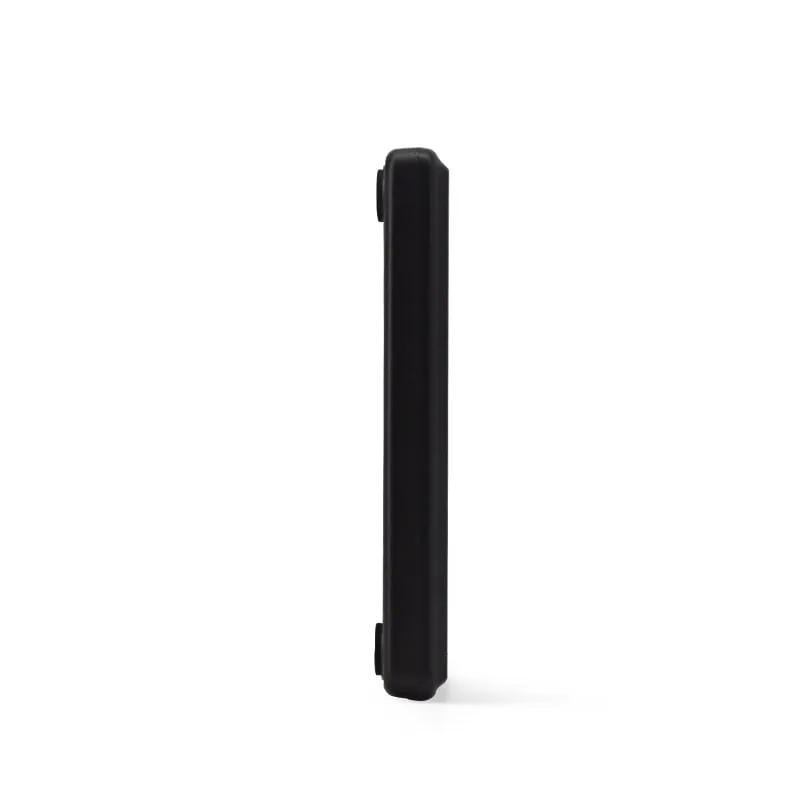 13.56MHz
 H110-U
13.56MHz USB NFC / MIFARE Card Reader, Slim Pad, No Driver
- USB
- Desktop
Read range: Up to 80 mm
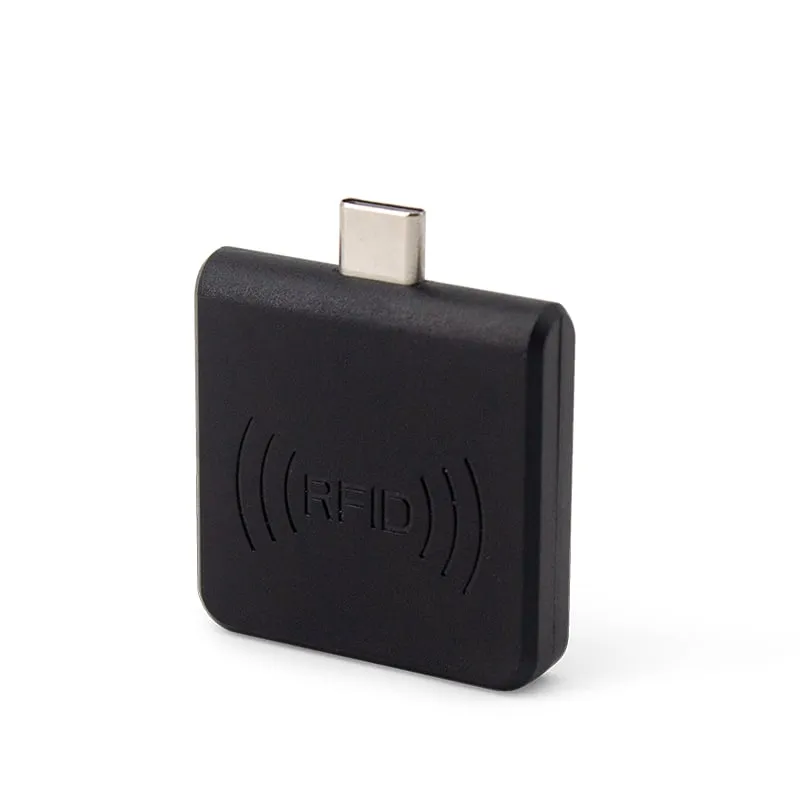 125kHz
 L220-C
USB-C 125kHz EM4100 RFID Reader for Android Phones
- USB
- Plug-in
Read range: 0–30 mm front and back, 0–10 mm from the side
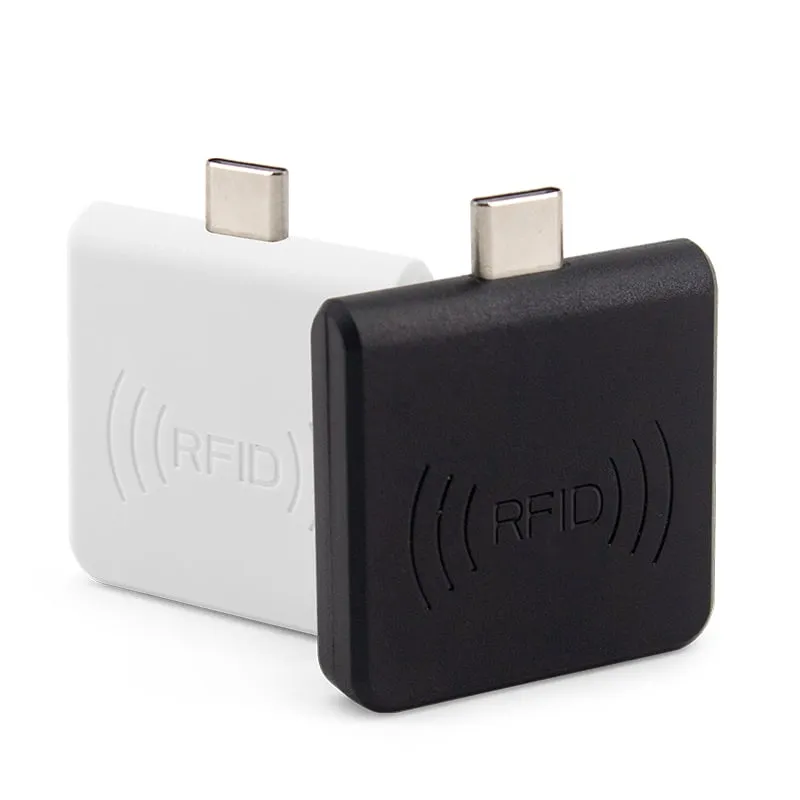 13.56MHz
 H220-C
USB-C 13.56MHz NFC Reader for Android Phones, MIFARE UID
- USB
- Plug-in
Read range: 0–30 mm front and back, 0–10 mm from the side
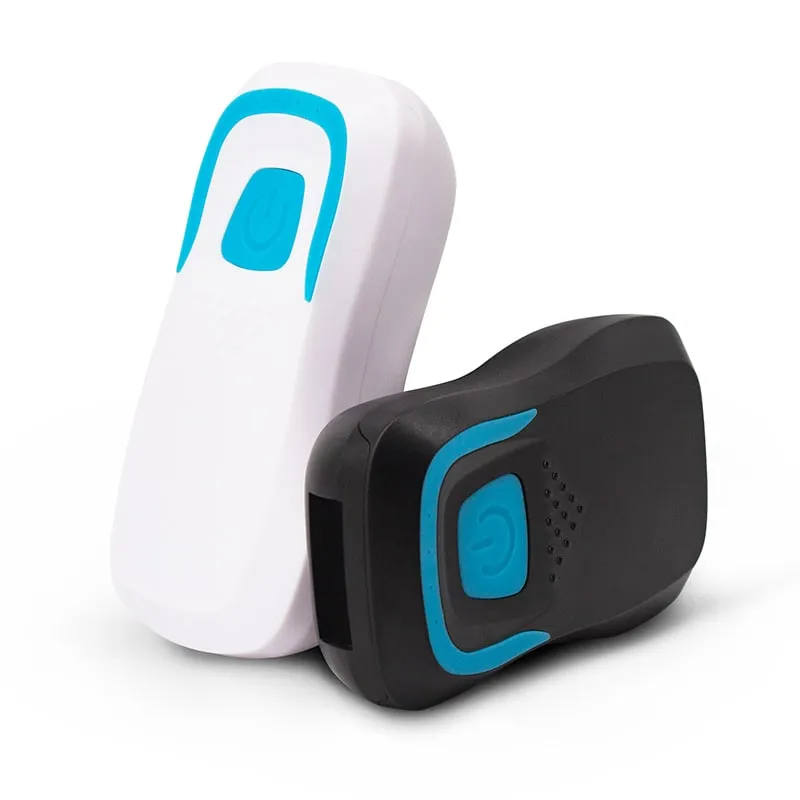 13.56MHz
 H510-B+2 variants
Bluetooth RFID Card Reader, 13.56MHz NFC / 125kHz, Pocket
- Wireless
- Handheld
Read range: 20–60 mm