Selection guides
ISO 14443 vs ISO 15693: Proximity Cards, Vicinity Tags and Choosing an HF Reader
By Henrium · · 9 min read
Quick answer
ISO/IEC 14443 and ISO/IEC 15693 both run at 13.56 MHz but use different air interfaces. ISO 14443 proximity cards such as MIFARE and NTAG work within about 10 cm and suit access, payment and ID. ISO 15693 vicinity tags such as ICODE wake in a weaker field, read farther with large antennas and suit library and item labels.
ISO/IEC 14443 and ISO/IEC 15693 are the two main card standards at 13.56 MHz. Both use the same carrier frequency, both are called HF RFID, and most NFC phones read both. They are still different radio interfaces, and a reader built for one usually cannot see the other’s tags.
This guide compares the two standards, explains why ISO 15693 tags read farther, shows which applications use which, and gives a checklist for choosing an HF reader. If you still need to rule out 125 kHz, start with 125kHz vs 13.56MHz.
The short answer
- ISO/IEC 14443 (“proximity”) covers cards designed to be read within about 10 cm: access, membership, transit, payment and ID cards. MIFARE Classic, MIFARE Ultralight, NTAG and MIFARE DESFire use it. It comes in two variants, Type A and Type B.
- ISO/IEC 15693 (“vicinity”) covers labels that can be read farther away with large antennas, up to around 1 m in favorable setups: library books, files, laundry and item labels. The ICODE family and similar chips use it.
- Reader support is per standard. Many reader chips handle both, but a finished reader supports only what its firmware implements. Check the specification for the exact standard, not just “13.56 MHz”.
Side-by-side comparison
| Feature | ISO/IEC 14443 | ISO/IEC 15693 |
|---|---|---|
| Name in the standard | Proximity card or object (PICC) | Vicinity card or object (VICC) |
| Parts | 1 physical, 2 RF power and signal, 3 initialization and anticollision, 4 transmission protocol | 1 physical, 2 air interface and initialization, 3 anticollision and transmission protocol |
| Carrier | 13.56 MHz | 13.56 MHz |
| Field strength the card must work in | 1.5 to 7.5 A/m | 0.15 to 5 A/m |
| Typical read range | Up to about 10 cm | Similar to ISO 14443 on desktop readers; up to around 1 m with large antennas |
| Reader-to-card signal | Type A: 100% ASK, modified Miller; Type B: 10% ASK, NRZ | 10% or 100% ASK, pulse-position coding (1 of 4 or 1 of 256) |
| Card-to-reader signal | Load modulation on an 847.5 kHz subcarrier | Load modulation on one (423.75 kHz) or two (423.75 / 484.28 kHz) subcarriers |
| Data rate | 106 kbit/s base; 212, 424 and 848 kbit/s optional | About 26 kbit/s at the high rate; lower rates for longer range |
| UID | Type A: 4, 7 or 10 bytes; Type B: 4-byte PUPI | 8 bytes, top byte E0 |
| Anticollision | Type A: bit-wise, by cascade level; Type B: time slots | Inventory in 16 slots or 1 slot, with an optional mask |
| Memory access | Chip-specific; Part 4 carries ISO/IEC 7816-4 commands | Standard block commands (read, write, lock) plus AFI and DSFID bytes |
| Security | From none up to AES and public-key cryptography on Part 4 chips | Mostly passwords or none; some newer chips add AES |
| NFC name | NFC-A and NFC-B (Forum Types 1, 2 and 4) | NFC-V (Forum Type 5) |
| Example chips | MIFARE Classic, Ultralight, NTAG21x, DESFire | ICODE SLIX, ICODE SLIX2, ICODE DNA |
| Typical uses | Access, attendance, membership, transit, payment, ePassports | Libraries, archives, laundry, sample and item labels |
Why ISO 15693 reads farther
The key number is the minimum field strength. An ISO 14443 card must work from 1.5 A/m; an ISO 15693 tag must work from 0.15 A/m, ten times less. The magnetic field of a reader’s loop antenna falls off steeply, roughly with the cube of distance once you are farther away than the antenna’s radius. A tag that wakes up in a field ten times weaker can therefore sit a good deal farther from the same antenna.
Range still depends mostly on the antenna and the reader’s power. A large gate or pad antenna driven by a higher-power reader reaches tens of centimeters to around a meter, and vendors quote different figures for similar setups. A desktop reader with a card-sized antenna reads both standards at similar distances: our ISO 15693 desktop reader, the H155-U USB reader for ICODE tags, is specified at up to 80 mm, the same figure as ISO 14443A desktop models such as the H150-U.
The shorter range of ISO 14443 is deliberate. A payment or door card should respond only when its holder brings it close to a reader on purpose.
ISO 14443 in practice: Type A, Type B and Part 4
Most cards in access, attendance and membership systems are Type A: MIFARE Classic 1K and 4K, MIFARE Ultralight and NTAG. Type B uses a different modulation and anticollision scheme and appears mainly in some government ID documents and transit schemes. A reader that lists “ISO 14443A” does not necessarily read Type B.
Part 4 of the standard adds a transmission protocol that carries ISO/IEC 7816-4 smart-card commands. Chips that use it, such as MIFARE DESFire, contactless payment cards and ePassports, can run authenticated, encrypted sessions. A UID reader uses none of that: it identifies the card by its UID. The MIFARE Classic vs Ultralight vs NTAG213 guide covers the common Type A chips and their UID lengths.
ISO 15693 in practice: UID, AFI and inventory
An ISO 15693 tag has a 64-bit UID. The top byte is always E0, the next byte is the chip maker’s code (04 for NXP) and the remaining 48 bits are the serial number. The tag transmits the least significant byte first, so apps and readers show the UID either as E0 04 … or in reverse order. RFID card number formats explains how that affects stored numbers.
Two single-byte fields matter to integrators:
- AFI (Application Family Identifier) lets a reader address only tags of one application family. Library systems use it, or a chip’s EAS bit, as the security flag that the exit gates check.
- DSFID (Data Storage Format Identifier) tells software how the tag’s memory is organized.
The inventory command is built for many labels in one field, such as a stack of books on a staff pad. The reader opens 16 time slots, each tag answers in the slot that matches four bits of its UID, and the reader repeats with a longer mask until it has collected every UID.
Two related standards appear in tenders and tag datasheets. ISO/IEC 18000-3 Mode 1 is the item-management air interface based on ISO 15693, and ISO 28560 defines how library data is stored on the tag. The NFC Forum’s Type 5 Tag specification, listed on the NFC Forum specifications page, is what makes these tags readable by NFC phones.
Which standard fits which application
| Application | Usual HF standard | Why |
|---|---|---|
| Door access, attendance, canteen, membership | ISO 14443A | Low-cost cards, short deliberate taps, wide reader choice |
| Secure campus and corporate cards | ISO 14443A with Part 4 chips | Authentication with keys |
| NFC stickers, smart posters, product tags | ISO 14443A (NFC Forum Type 2) | Every NFC phone reads them |
| Library books and media | ISO 15693 | Gate range, stack reading, ISO 28560 data model |
| Archive files, sample tubes, lab and asset labels | ISO 15693 | Thin labels, several items in one field |
| Laundry and textile tags | ISO 15693 or UHF | Varies by system; check the tag |
| Transit and ID documents | ISO 14443 Type A or B | Set by the scheme operator |
When cards or labels already exist, the tags decide, not the application. A new item-tracking project can also consider UHF for longer range; inventory and asset tracking compares the options.
How to tell which standard your tag uses
- Check the chip name. The card or label datasheet names the chip. MIFARE and NTAG are ISO 14443A; ICODE is ISO 15693.
- Use an NFC phone. An Android tag-info app lists the technologies a tag reports: NfcA or ISO 14443-3A for Type A, NfcV or ISO 15693 for vicinity tags.
- Look at the UID. 4 or 7 bytes points to ISO 14443A. 8 bytes with
E0at one end points to ISO 15693. - Consider where it came from. A label inside a library book or on an archive box is probably ISO 15693. A staff card or key fob is probably ISO 14443A, or 125 kHz.
- Test on the real reader before a volume order. Request samples or send a tag with your inquiry.
What our HF readers support
Our 13.56 MHz range splits along the two standards. Every model is read-only and outputs the tag UID.
| Standard | Models | Tags listed | Host link |
|---|---|---|---|
| ISO/IEC 14443A | H110-U, H120-U, H130-U, H150-U, H210-U, H310-U | MIFARE Classic 1K/4K, NTAG203; NTAG213 on the H150-U | USB |
| ISO/IEC 14443A | H110-R, H150-R | MIFARE Classic 1K/4K, NTAG203, NTAG213 | RS232 |
| ISO/IEC 14443A | H220-C USB-C NFC reader, H510-B | MIFARE Classic 1K/4K, NTAG203; NTAG213 on the H510-B | USB-C for Android; Bluetooth |
| ISO/IEC 14443A | H410-W version of the L410-W | MIFARE Classic 1K/4K | Wiegand 26/34 |
| ISO/IEC 14443A | Q420-M and Q430-M QR code + RFID access readers | MIFARE cards, plus 125 kHz EM cards and QR codes | Wiegand, RS232, RS485; USB on the Q430-M |
| ISO/IEC 15693 | H155-U | ICODE 2 and similar vicinity tags | USB |
The H155-U shares its angled desk housing with the H150-U. A site that uses MIFARE staff cards and ICODE item labels can run both readers side by side in one desk format, but our range has no single reader that reads both standards.
Not listed for any model in our range: ISO 14443B, FeliCa, MIFARE DESFire and MIFARE Plus (other ISO 14443A cards may still return a UID, so test a sample); reading or writing tag memory, AFI or EAS on ISO 15693 tags; and the gate, shelf and self-checkout readers used in library automation. The H155-U lists ICODE 2. ICODE SLIX-family tags are ISO 15693 but not named, so test them on a sample first. The H155-U outputs a 10-digit decimal by default; if your system stores the full 8-byte UID, say so when you order.
How to choose an HF reader: checklist
- Identify the standard of the tags you already have, using the steps above. The reader follows the tags.
- Decide what you need from the tag. Identifying an item or person needs only the UID. Reading library data, changing a security flag or opening secure card applications needs a read/write reader and software.
- Match range to the job. A staff desk needs a few centimeters. Gates and shelves need antennas and readers built for that job.
- Fix the UID format. ISO 14443A UIDs are 4 or 7 bytes; ISO 15693 UIDs are 8 bytes. Decide what your database stores and have the reader output exactly that.
- Choose the host link: USB keyboard output for desk software, RS232 for serial hosts, Wiegand for access controllers, USB-C NFC readers for Android devices. The keyboard-emulation readers need no driver.
- Plan mixed sites. A site with both tag types needs either two readers or one reader specified for both standards. In our range, pair an ISO 14443A model with the H155-U.
- Test with production tags and your own software before ordering in volume.
Compare all models on the 13.56MHz NFC and HF readers page. For phone-based reading, see NFC reader vs RFID reader.
Frequently asked questions
Can an ISO 14443 reader read ISO 15693 tags?
Only if it also implements ISO 15693. Many reader chips support both standards, but a finished reader reads only what its firmware and specification list. Our ISO 14443A readers are not specified for ISO 15693 tags, and the H155-U is specified for ISO 15693 only. Our range has no single reader for both, so a mixed site uses two readers.
Is ISO 15693 the same as NFC?
ISO 15693 tags are NFC Forum Type 5 tags, also called NFC-V, so most NFC phones can read them: Android through its NfcV class and iPhones through Core NFC. A phone reads them at a short distance, because its antenna is small.
How far can an ISO 15693 tag be read?
It depends mainly on the reader antenna and the tag size. Desktop readers read a few centimeters; our H155-U is specified at up to 80 mm. Large gate or pad antennas with higher-power readers can reach tens of centimeters to around 1 m, and vendors quote different figures.
What is the difference between ISO 14443A and ISO 14443B?
Both are proximity interfaces at 13.56 MHz, but they use different modulation and anticollision schemes. Type A covers MIFARE and NTAG cards used in most access and membership systems; Type B appears mainly in some government ID and transit cards. Our 13.56 MHz readers list Type A only.
Which standard is more secure?
ISO 14443-4 chips can run strong cryptography, which is why payment cards and ePassports use ISO 14443. Most ISO 15693 labels offer passwords at most. For a UID reader the question does not arise: a UID identifies a tag, and it is not a secret.
Readers mentioned in this guide
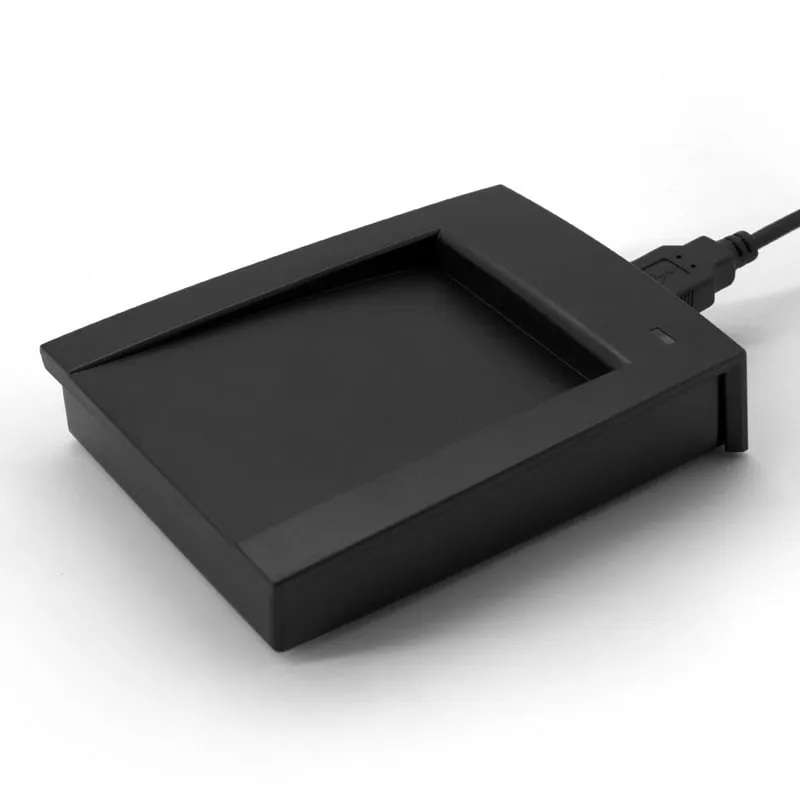 13.56MHz
 H155-U
ISO 15693 USB RFID Reader for ICODE Tags, 13.56MHz Desktop
- USB
- Desktop
Read range: Up to 80 mm
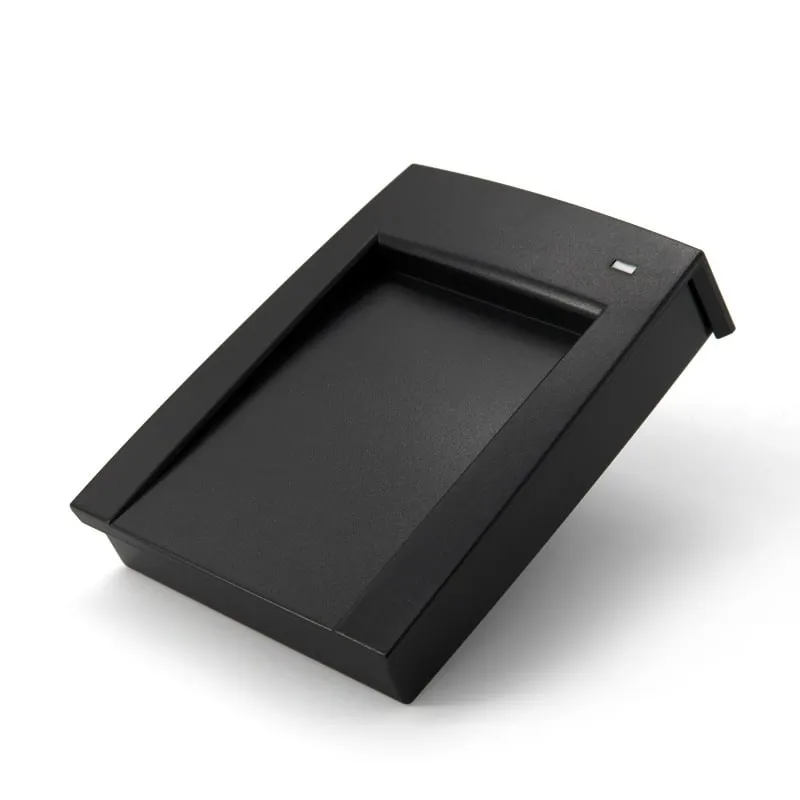 13.56MHz
 H150-U
13.56MHz USB MIFARE Reader, Angled Desktop with Card Recess
- USB
- RS232
- Desktop
Read range: Up to 80 mm
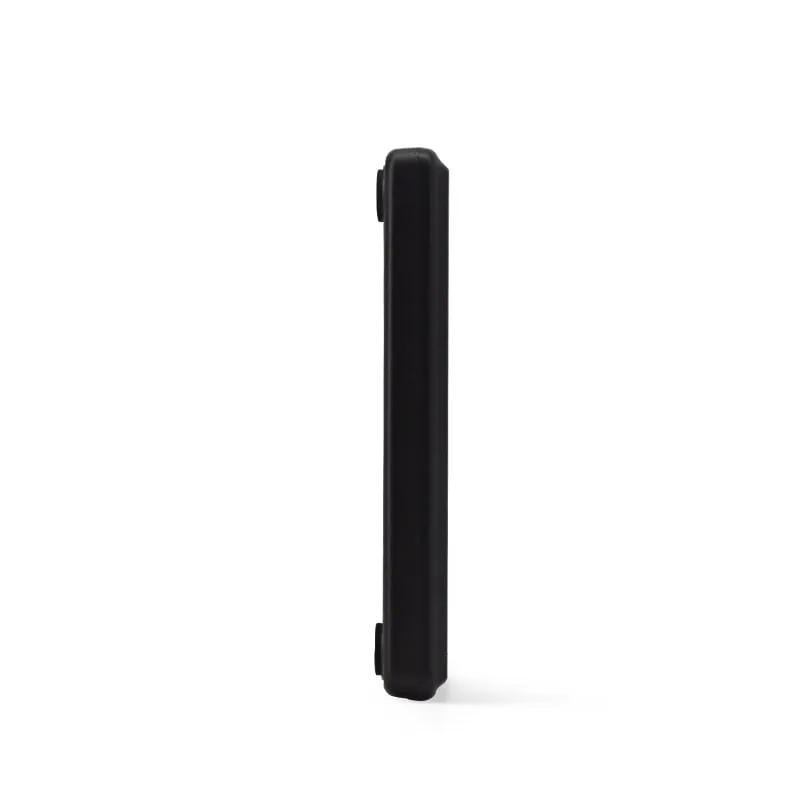 13.56MHz
 H110-U
13.56MHz USB NFC / MIFARE Card Reader, Slim Pad, No Driver
- USB
- Desktop
Read range: Up to 80 mm